

Cancer represents one of Vietnam’s most significant long-term healthcare challenges.
According to the International Agency for Research on Cancer (IARC), the GLOBOCAN 2022 estimates identified approximately 180,480 new cancer cases and 120,184 cancer-related deaths in Vietnam.
That was equivalent to almost 500 new cancer diagnoses every day.
More recent estimates, published in July 2026 through GLOBOCAN 2024, put Vietnam’s annual cancer incidence at approximately 177,404 new cases, with 111,015 deaths. The updated figures are slightly lower, but they do not change the fundamental conclusion: Vietnam faces an annual cancer burden approaching 180,000 new diagnoses.
For healthcare providers, policymakers and diagnostic laboratory investors, these figures raise an important question.
How much pathology infrastructure does a country need to support nearly 180,000 new cancer diagnoses every year?
The answer involves considerably more than counting cancer patients.
Each confirmed case may represent multiple diagnostic procedures, tissue samples, laboratory investigations and specialist consultations.
And the number of patients requiring pathology services extends well beyond those ultimately diagnosed with cancer.
Why Cancer Incidence Creates Greater Demand for Pathology
Pathology is central to modern cancer diagnosis.
Imaging technologies such as ultrasound, CT, MRI and PET scans can identify suspicious abnormalities. However, examination of tissue or cells is often necessary to establish the diagnosis, determine the cancer type and identify characteristics that influence treatment.
A typical diagnostic process may involve a biopsy, tissue processing, microscopic examination and additional laboratory investigations.
Depending on the cancer, pathologists may also perform immunohistochemistry, molecular testing or other specialised examinations.
Importantly, not every biopsy reveals cancer.
Patients with benign tumours, inflammatory conditions, suspicious lesions or abnormal screening results may also require histopathological examination.
Consequently, the total volume of pathology investigations is substantially larger than the number of newly diagnosed cancer cases.
For Vietnam’s healthcare system, the approximately 180,000 annual cancer diagnoses represent only one component of overall pathology demand.
One Cancer Patient Can Generate Multiple Laboratory Investigations
Cancer diagnosis is rarely a single laboratory event.
Consider a patient presenting with a suspicious breast lesion.
The diagnostic pathway may begin with a core needle biopsy. A pathologist examines the tissue to determine whether malignant cells are present.
If breast cancer is confirmed, further testing may be necessary to evaluate biomarkers such as oestrogen receptor (ER), progesterone receptor (PR), HER2 and Ki-67.
These results help clinicians classify the tumour and select appropriate treatments.
Additional specimens may subsequently be examined following surgery or when the disease progresses.
Other cancers create different testing requirements.
Lung cancer may require molecular biomarker testing to identify actionable genetic alterations. Colorectal cancer may involve mismatch repair or other molecular testing. Lymphoma diagnosis can require extensive immunohistochemical panels and specialist interpretation.
The important point is that one patient may generate several tests across different laboratory disciplines.
This creates continuing demand for histopathology, immunohistochemistry, molecular pathology and specialist consultation.
The Five Major Cancer Types Shape Vietnam’s Laboratory Requirements
Vietnam’s cancer profile also influences the type of pathology infrastructure required.
According to GLOBOCAN 2024, the five most frequently diagnosed cancers in Vietnam were breast, lung, colorectal, liver and stomach cancer.
Estimated new cancer cases in Vietnam, 2024
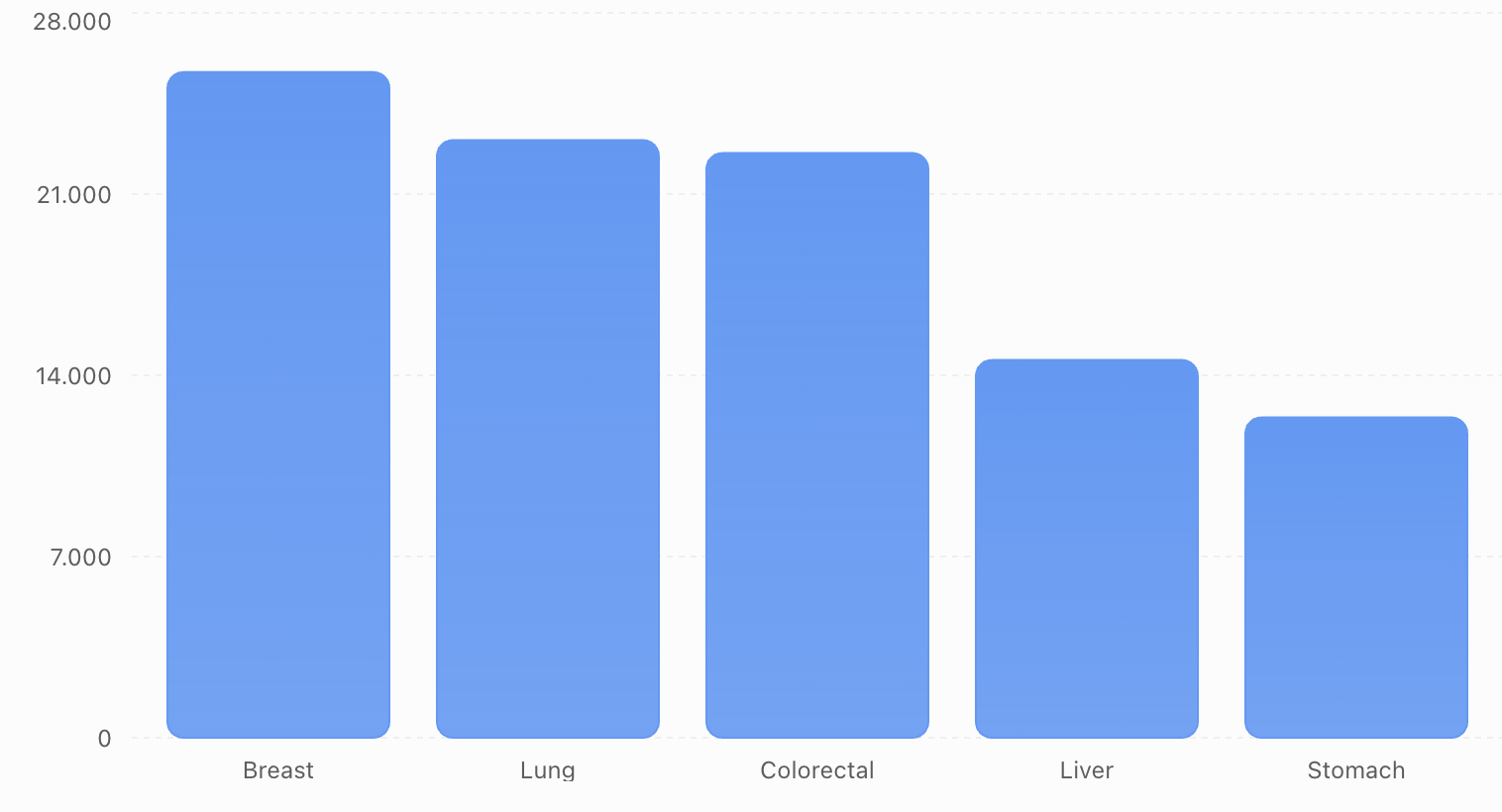
Source: IARC GLOBOCAN 2024, published July 2026
These cancers require different diagnostic capabilities.
Breast cancer creates demand for tissue examination and biomarker assessment. Lung cancer increasingly requires integrated histological and molecular diagnosis. Colorectal cancer generates substantial surgical pathology workloads, while gastrointestinal and liver cancers create additional requirements for biopsy interpretation and tumour classification.
A national pathology strategy cannot therefore focus exclusively on increasing the number of laboratories.
It must also consider which diagnostic capabilities are available, where they are located and how reliably they operate.
Diagnostic Quality Matters as Much as Laboratory Capacity
Expanding testing volume without maintaining diagnostic quality creates significant clinical risks.
In cancer care, a pathology result can determine whether a patient receives surgery, chemotherapy, hormone therapy, immunotherapy or targeted treatment.
This makes consistency between laboratories particularly important.
A study published in 2025 examined the reproducibility of breast cancer immunohistochemistry testing across 10 Vietnamese hospitals.
Researchers evaluated ER, PR, HER2 and Ki-67 testing.
ER demonstrated relatively strong reproducibility, with a coefficient of variation of 4.8%.
Ki-67 showed greater variability, with a coefficient of variation of 17%. Agreement for HER2-low classification was also comparatively weak, with a kappa statistic of 0.323.
These findings measured interlaboratory reproducibility, not the percentage of incorrect diagnoses. Nevertheless, they demonstrate why standardisation and external quality assessment are essential to cancer diagnostics.
For pathology operators, reliable performance requires investment in specimen handling, validated staining procedures, equipment maintenance, staff training and quality-control programmes.
The commercial value of a laboratory ultimately depends not only on how many tests it processes, but also on whether clinicians can trust its results.
Vietnam’s Pathology Workforce Is Another Critical Constraint
Increasing laboratory capacity is partly an infrastructure problem.
But it is also a workforce problem.
Modern histopathology depends on qualified pathologists who can interpret complex tissue specimens, integrate clinical information and provide accurate diagnostic conclusions.
These specialists require years of medical education and professional training.
Unlike laboratory equipment, experienced pathologists cannot be acquired simply through capital expenditure.
Furthermore, pathology expertise is not interchangeable across every cancer category.
A specialist in breast pathology may possess different expertise from a haematopathologist examining lymphoma or a pathologist interpreting complex gastrointestinal tumours.
This creates an opportunity for laboratories and hospitals to develop referral networks and shared specialist services.
Routine specimens can be processed closer to patients, while difficult cases can be referred to centres with appropriate expertise.
Such a model may improve access to specialised diagnostics without requiring every provincial hospital to maintain a full complement of subspecialist pathologists.
Digital Pathology Could Help Expand Specialist Access
Digital pathology offers one potential response to these constraints.
Whole-slide imaging enables conventional glass pathology slides to be scanned into high-resolution digital images.
These images can then be reviewed remotely by appropriately qualified specialists.
A study published in Modern Pathology in 2025 examined a telepathology collaboration between Ho Chi Minh City Oncology Hospital and the University of Texas Health Science Center at Houston’s McGovern Medical School.
Over 32 months, researchers reviewed 71 difficult haematopathology cases.
A definitive consensus diagnosis was achieved in 97% of cases, while average turnaround time decreased by approximately 30% compared with traditional local consultation using glass slides.
The study was relatively small and focused on selected complex cases. Its results should not be interpreted as evidence that digital pathology can replace conventional pathology services.
However, it demonstrates that specialist expertise can be shared across geographical boundaries.
For Vietnam, this has important implications.
A hospital in a provincial city may not need to employ every pathology subspecialist locally if it can access a reliable remote consultation network.
Digital pathology could support second opinions, complex diagnostic reviews, professional training and collaboration between laboratories.
The model still requires suitable scanners, information systems, validated procedures, secure data management and qualified pathologists.
Technology expands access to expertise; it does not eliminate the need for expertise.
What Does This Mean for Pathology Laboratory Investment?
Vietnam’s cancer burden creates several potential opportunities for diagnostic laboratory investment.
The most obvious is additional histopathology capacity.
As hospitals expand cancer screening, diagnostic imaging and surgical services, demand for tissue processing and microscopic examination may increase.
A second opportunity lies in specialised testing.
Immunohistochemistry and molecular pathology are increasingly important in treatment selection. Laboratories capable of delivering validated, clinically relevant biomarker results may play a larger role in oncology care.
A third opportunity is the development of regional referral networks.
Rather than requiring every hospital to build a comprehensive pathology department, centralised laboratories could provide advanced services to multiple healthcare institutions.
This model may create advantages through equipment utilisation, specialist concentration, procurement efficiencies and consistent quality management.
However, cancer incidence alone is not sufficient to estimate commercial market size.
Investors must also consider specimen volumes, reimbursement levels, test utilisation, referral agreements, operating costs and the availability of trained personnel.
A laboratory processing a large number of routine specimens may have a very different financial profile from one specialising in complex molecular oncology.
The key commercial question is not simply how many cancer patients Vietnam has, but how diagnostic demand is distributed across tests, institutions and levels of clinical complexity.
Earlier Cancer Detection Could Increase Pathology Workloads
Vietnam’s diagnostic requirements may also change as cancer screening and early detection improve.
The World Health Organization emphasises that timely diagnosis and access to appropriate diagnostic services are essential components of effective cancer control.
When more patients undergo screening, clinicians may identify additional suspicious lesions requiring investigation.
This can increase demand for cytology, biopsy processing and histopathological assessment, including examinations that ultimately confirm benign disease.
Earlier detection may improve treatment opportunities, but it also requires laboratories capable of processing specimens within clinically appropriate turnaround times.
Therefore, successful cancer-screening programmes depend partly on the strength of the diagnostic infrastructure supporting them.
Screening capacity without sufficient pathology capacity risks creating bottlenecks between detection and treatment.
Building the Next Generation of Pathology Services in Vietnam
Vietnam’s pathology sector is likely to require a combination of expanded laboratory capacity, higher diagnostic standards and more effective collaboration between healthcare institutions.
Future development could include centralised reference laboratories, regional specimen collection networks, expanded immunohistochemistry services, molecular testing platforms and digitally connected specialist teams.
These capabilities should be developed according to actual clinical demand rather than equipment availability alone.
For hospital administrators, the priority is ensuring timely and reliable diagnoses.
For laboratory operators, it is building sustainable workflows that balance throughput, quality and specialist expertise.
For investors, the opportunity is to create diagnostic infrastructure that can serve multiple hospitals and support increasingly sophisticated cancer treatment.
Importantly, the growth of pathology services should not be viewed purely as a consequence of rising cancer incidence.
It also reflects improvements in healthcare access, more comprehensive diagnostic pathways and the increasing use of biomarker-guided treatment.
Conclusion: Cancer Care Depends on Diagnostic Infrastructure
Vietnam’s annual cancer burden, estimated at more than 180,000 new cases in 2022 and approximately 177,000 in the updated 2024 dataset, illustrates the scale of the country’s oncology challenge.
But cancer incidence is only the starting point for understanding pathology demand.
Every biopsy, tissue sample, biomarker investigation and specialist review adds another layer to the diagnostic workload.
The next stage of Vietnam’s pathology development will therefore depend on more than purchasing laboratory equipment.
It will require reliable diagnostic networks, consistent quality standards, specialised medical expertise and better access to advanced testing.
For Vietnam’s healthcare sector, the long-term opportunity is not simply to perform more pathology tests. It is to build the diagnostic infrastructure that makes accurate, timely and increasingly personalised cancer treatment possible.