
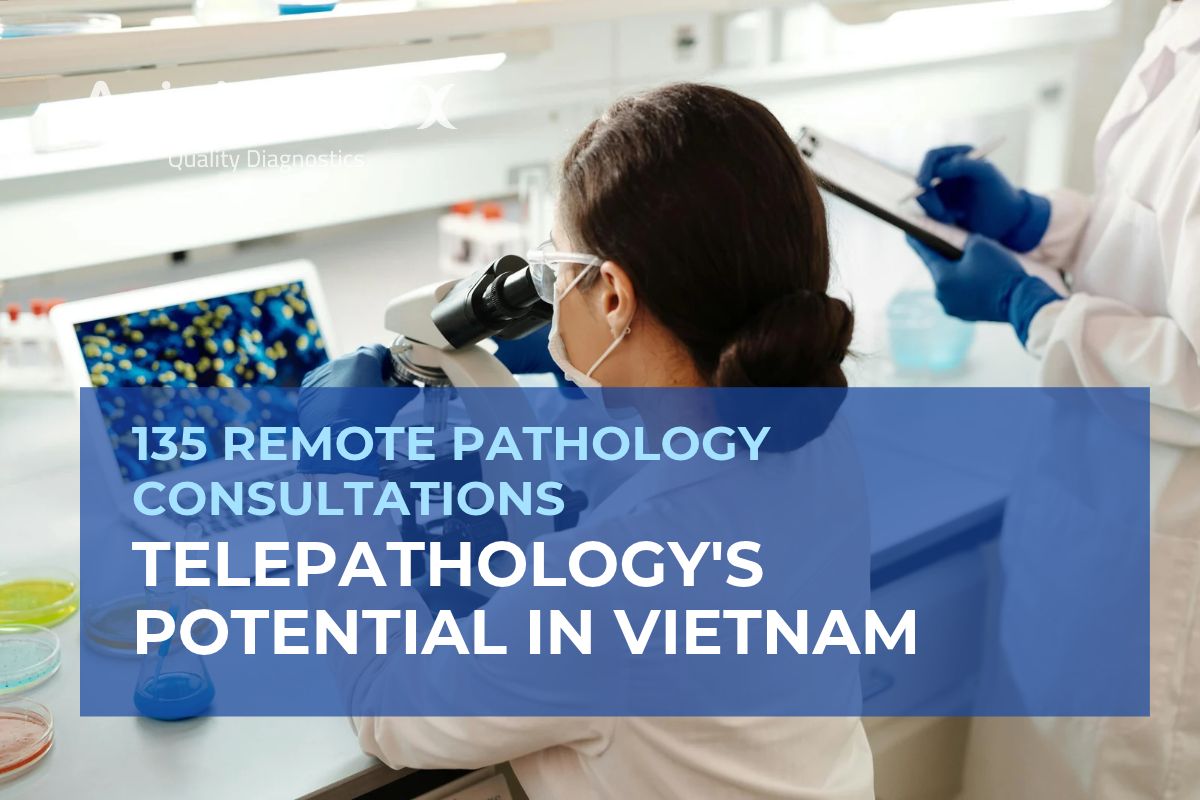
A pathologist in Vietnam examines a patient specimen under a microscope.
Thousands of kilometres away, a specialist in the United States reviews the same microscopic images through a secure video connection.
The two physicians discuss what they see, consider the patient’s clinical information and work toward a diagnosis.
The physical glass slides remain in Vietnam.
This is not a hypothetical example of future healthcare technology.
It is the operating model examined in a Vietnamese hematopathology collaboration published in the American Journal of Clinical Pathology in 2024.
The study documented 135 remote pathology consultations over two years, including 53 consultations involving blood and bone marrow.
The programme connected pathologists at Ho Chi Minh City Blood Transfusion Hematology Hospital with a board-certified hematopathologist in the United States.
One of its most important findings involved the diagnosis of T-cell large granular lymphocytic leukemia, a rare blood disorder that can be difficult to recognise without specialised expertise.
The researchers reported that diagnoses of this condition made through the programme were subsequently confirmed by in-person microscopic review.
The findings point to an important possibility for Vietnam’s diagnostic industry.
Specialist pathology expertise may not always need to be physically located in the same laboratory as the patient specimen.
For a country where pathology expertise has historically been concentrated in major medical centres, this could have significant implications for healthcare access, laboratory investment and the development of regional diagnostic networks.
What Did the Vietnamese Telepathology Study Find?
The research, titled T-cell Large Granular Lymphocytic Leukemia in Vietnam: Using Microscope-to-Screen Videoconferencing to Improve Diagnosis, examined a collaborative programme designed to improve hematopathology diagnosis and education.
Hematopathology is a specialised branch of pathology concerned with diseases affecting blood, bone marrow and lymphoid tissues.
These include leukemia, lymphoma and other blood disorders.
Accurate diagnosis can require detailed microscopic interpretation, clinical information and additional laboratory investigations.
The programme allowed Vietnamese pathologists to consult a US-based specialist through real-time video communication.
Rather than sending physical glass slides overseas, participating physicians used a microscope equipped with a digital camera and imaging software.
The US specialist could observe the microscopic findings, discuss the case and provide diagnostic guidance.
Over a two-year period, researchers recorded 135 consultations.
Of these, 53 concerned blood and bone marrow.
T-cell large granular lymphocytic leukemia was among the frequently discussed bone marrow diagnoses.
The researchers reported that the programme contributed to the first documented Vietnamese diagnoses of this condition identified through their investigation of existing records and physician surveys.
All diagnoses of this particular condition reviewed through subsequent in-person microscopy were confirmed.
The result is encouraging, but it requires careful interpretation.
The reported 100% concordance applied to the specific T-cell large granular lymphocytic leukemia diagnoses examined. It was not a diagnostic accuracy rate for all 135 consultations.
Nevertheless, the study demonstrated that remote specialist collaboration could contribute meaningfully to difficult diagnostic cases.
How Can Pathologists Consult Without Shipping Physical Slides?
Traditional pathology relies on physical specimens and microscopic examination.
For histopathology, tissue samples are typically processed, embedded in paraffin, sectioned, stained and mounted on glass slides.
For hematopathology, physicians may examine blood films, bone marrow aspirates and tissue sections.
When a difficult case requires a second opinion, the laboratory may need to send slides or tissue blocks to another specialist.
This can introduce additional handling, transportation and administrative steps.
Telepathology offers an alternative.
In the Vietnamese study, the workflow was relatively straightforward.
A local pathologist prepared and examined the specimen using a microscope fitted with a digital camera.
The microscope images were displayed on a computer.
Through secure videoconferencing, the remote specialist could participate in a live review while the local pathologist controlled the microscope.
Both physicians could discuss diagnostic features and consider additional clinical information.
The physical specimen remained at the Vietnamese hospital.
Importantly, the programme did not depend on a fully automated whole-slide imaging system.
The researchers selected a microscope-to-screen approach partly because high-resolution slide-scanning technology was expensive and could be unsuitable for certain detailed blood and bone marrow examinations.
This distinction matters for emerging healthcare markets.
Remote specialist consultation does not always require the most expensive digital pathology infrastructure.
In some circumstances, appropriate microscopy equipment, reliable connectivity and a structured consultation process may provide a practical starting point.
Why Hematopathology Requires Specialised Expertise
Hematopathology is particularly relevant to the question of remote specialist access.
Blood cancers and related disorders can be diagnostically complex.
Different diseases may produce similar symptoms, laboratory findings or microscopic appearances.
Accurate classification can require an understanding of cell morphology, immunophenotyping, molecular abnormalities and clinical context.
For example, T-cell large granular lymphocytic leukemia is a rare disorder involving abnormal populations of large granular lymphocytes.
Its clinical presentation can overlap with other haematological conditions.
Distinguishing it from alternative diagnoses may require specialised knowledge and appropriate supporting investigations.
Without sufficient expertise, rare conditions may be overlooked or classified incorrectly.
The Vietnamese programme addressed this challenge through direct collaboration between a local pathologist and an experienced international specialist.
The remote expert did not replace the local physician.
Instead, the consultation combined knowledge of the patient’s clinical circumstances with specialist diagnostic interpretation.
This approach has implications beyond hematopathology.
Similar collaborative models may be relevant to difficult cases in surgical pathology, dermatopathology, neuropathology and other subspecialties, provided the imaging technology and clinical workflows are appropriate.
A Second Vietnamese Study Supports the Potential of Remote Pathology
The 135-consultation programme is not the only published example of telepathology collaboration involving Vietnam.
A separate study published in Modern Pathology in August 2025 examined cooperation between Ho Chi Minh City Oncology Hospital and the University of Texas Health–McGovern Medical School.
Over 32 months, researchers reviewed 71 hematopathology cases submitted for remote consultation.
A definitive consensus diagnosis was reached in 97% of cases.
The researchers also reported that average diagnostic turnaround time was approximately 30% shorter than traditional local consultation using glass slides.
The programme included an educational component designed to strengthen the diagnostic capabilities of participating Vietnamese pathologists.
These findings support the potential value of structured international specialist collaboration.
However, the studies should not be treated as interchangeable.
The 2024 study examined a microscope-to-screen consultation model and highlighted the diagnosis of a particular rare blood disorder.
The 2025 study evaluated a separate programme using digital pathology methods and reported different outcomes.
Neither study establishes that all remote pathology services will achieve the same results.
Both nevertheless demonstrate that telepathology can be implemented in real clinical settings involving Vietnamese hospitals.
Vietnam’s Pathologist Shortage Makes Remote Consultation Relevant
The potential importance of telepathology becomes clearer when considering Vietnam’s specialist medical workforce.
A 2014 academic report on pathology and telepathology in Vietnam estimated that the country had approximately 366 pathologists at that time.
Most were concentrated in major cities and provincial hospitals.
This is a historical estimate rather than a current workforce count.
However, it illustrates a longstanding challenge: specialist pathology expertise has not been evenly distributed across the country.
Building a new laboratory requires financial investment.
Developing an experienced pathology department requires something more difficult to obtain.
Qualified physicians.
Specialists need years of education, supervised clinical experience and continuing professional development.
Subspecialty expertise may require additional training and exposure to complex cases.
This creates an important difference between expanding equipment capacity and expanding medical expertise.
A laboratory may purchase advanced staining instruments or digital imaging equipment relatively quickly.
It cannot create an experienced hematopathologist through capital expenditure alone.
Telepathology may help address part of this imbalance.
Instead of requiring every healthcare institution to employ specialists in every pathology subspecialty, a network could provide access to selected experts through structured remote consultation.
This would not eliminate the need for local pathologists.
But it could allow existing specialist expertise to support a wider number of healthcare providers.
Why Digital Pathology Could Change Laboratory Network Economics
The implications extend beyond clinical education.
They also affect the economic organisation of diagnostic laboratories.
Traditionally, specialised diagnostic capability is often associated with a particular physical location.
A hospital or laboratory develops a pathology department, recruits specialists and invests in equipment.
Its ability to provide complex diagnoses depends heavily on the expertise available at that facility.
Remote pathology introduces a different possibility.
Laboratories may remain geographically distributed while selected diagnostic expertise is shared across a network.
One facility could provide specimen collection, tissue processing and slide preparation.
Another location could host specialist pathologists who provide consultations when required.
A central reference laboratory might coordinate complex cases, quality assurance and additional testing.
This could allow smaller laboratories to access specialist capabilities without independently developing every subspecialty.
The potential economic benefits include improved specialist utilisation, reduced duplication of certain resources and broader access to advanced diagnostic services.
However, these benefits are not automatic.
Remote consultation still requires investment in imaging systems, secure information infrastructure, quality management and clinical governance.
Specialists must also have adequate time to review cases.
A network that increases consultation volume without maintaining sufficient medical capacity may create new delays rather than efficiencies.
The business opportunity depends on organising specialist expertise effectively, not simply connecting computers.
Telepathology Is Not the Same as Artificial Intelligence
Digital pathology and artificial intelligence are frequently discussed together.
But they are not the same technology.
Telepathology allows medical professionals to examine and discuss pathology images remotely.
Artificial intelligence systems may assist with tasks such as image analysis, tissue classification or identifying features requiring further review.
The Vietnamese 135-consultation study primarily examined specialist-to-specialist communication.
Its central innovation was the ability to connect medical expertise across geographic distance.
The diagnostic process remained dependent on qualified physicians.
This is an important distinction for healthcare investors.
A laboratory does not necessarily need to develop sophisticated artificial intelligence systems before it can benefit from digital pathology.
Establishing reliable digital consultation workflows may itself create clinical and operational value.
AI may eventually complement these workflows, subject to appropriate validation and regulatory requirements.
But the immediate opportunity demonstrated by the Vietnamese research was human expertise delivered through digital communication.
What Are the Limitations of Remote Pathology Consultation?
Despite encouraging findings, telepathology has important limitations.
Image quality must be sufficient for the diagnostic task.
Certain specimens require high magnification, precise focus or additional staining that may not be adequately represented through basic imaging systems.
Clinical information must be complete and reliable.
The reviewing specialist also needs access to relevant laboratory findings and, when necessary, additional diagnostic investigations.
Technical infrastructure creates further requirements.
Laboratories must maintain reliable internet connections, appropriate equipment and secure systems for transmitting patient information.
Data protection and medical confidentiality are essential.
Professional licensing, responsibility for diagnostic reports and cross-border medical consultation rules must also be addressed.
Another issue is quality assurance.
Remote pathology systems should be validated for their intended clinical applications, with clear procedures for cases that cannot be resolved remotely.
In some situations, physical slide review or referral to another laboratory will remain necessary.
The goal is not to eliminate traditional pathology.
It is to determine where remote collaboration can safely improve the diagnostic process.
What Does This Mean for Pathology Investment in Vietnam?
For investors considering Vietnam’s diagnostic laboratory industry, telepathology introduces another dimension to the investment thesis.
The opportunity may extend beyond acquiring equipment, building laboratory facilities or increasing routine testing volume.
It may involve developing systems that connect local laboratory operations with specialised medical expertise.
An established pathology laboratory with experienced physicians could potentially support a wider network of hospitals and diagnostic providers.
Smaller laboratories could obtain specialist consultation through structured partnerships.
Reference centres could combine advanced testing capabilities with educational programmes and quality assurance.
Such a model may be particularly relevant to histopathology and hematopathology, where experienced diagnostic specialists are difficult to recruit and develop.
For investment platforms such as AsiaLabs, which focuses on developing laboratory businesses including Anapath and Nguyễn Hoàng, these developments provide a relevant strategic consideration.
A connected laboratory model could potentially combine established local services with access to specialised expertise and selected shared infrastructure.
However, the published Vietnamese studies do not evaluate AsiaLabs, Anapath or Nguyễn Hoàng, and they do not establish the commercial performance of any particular laboratory network.
The investment implications are therefore strategic possibilities rather than demonstrated financial outcomes.
Successful implementation would require strong medical leadership, clinical quality systems, appropriate technology and regulatory compliance.
Conclusion: Specialist Expertise May Travel Further Than Physical Slides
The Vietnamese study documenting 135 remote pathology consultations offers an important lesson.
Advanced diagnostic capability is not determined solely by where laboratory equipment is located.
It also depends on access to experienced medical professionals.
By connecting a Vietnamese hospital with a US hematopathologist, the programme demonstrated a practical method for supporting difficult diagnoses without routinely transporting physical slides overseas.
The later study involving 71 cases at Ho Chi Minh City Oncology Hospital provided additional evidence that structured remote consultation can support diagnostic efficiency and specialist education.
Neither study proves that remote pathology can replace conventional diagnostic workflows or resolve Vietnam’s specialist workforce challenges on its own.
But both suggest that geography need not be an absolute barrier to expert consultation.
For Vietnam’s diagnostic industry, this creates an important opportunity.
Laboratories can potentially develop through networks that combine local specimen processing, specialised reference testing and remote access to experienced pathologists.
The result could be a more connected diagnostic system in which high-quality medical expertise is accessible to a wider range of healthcare providers.
The glass slides may need to remain in the laboratory. The specialist expertise does not always have to.
References:
1. Dayton, V. J., et al. (2024). T-cell large granular lymphocytic leukemia in Vietnam: Using microscope-to-screen videoconferencing to improve diagnosis. American Journal of Clinical Pathology, 161(2), 162–169. Read the study.
2. Telepathology in Hematopathology Diagnostics (2025). A Collaboration Between the Ho Chi Minh City Oncology Hospital and the University of Texas Health-McGovern Medical School. Modern Pathology, 38(8), 100779. Read the study.
3. Dang, D. V. (2014). Pathology and telepathology in Vietnam. Pathology, 46(Supplement 2), S8. Read the report.