
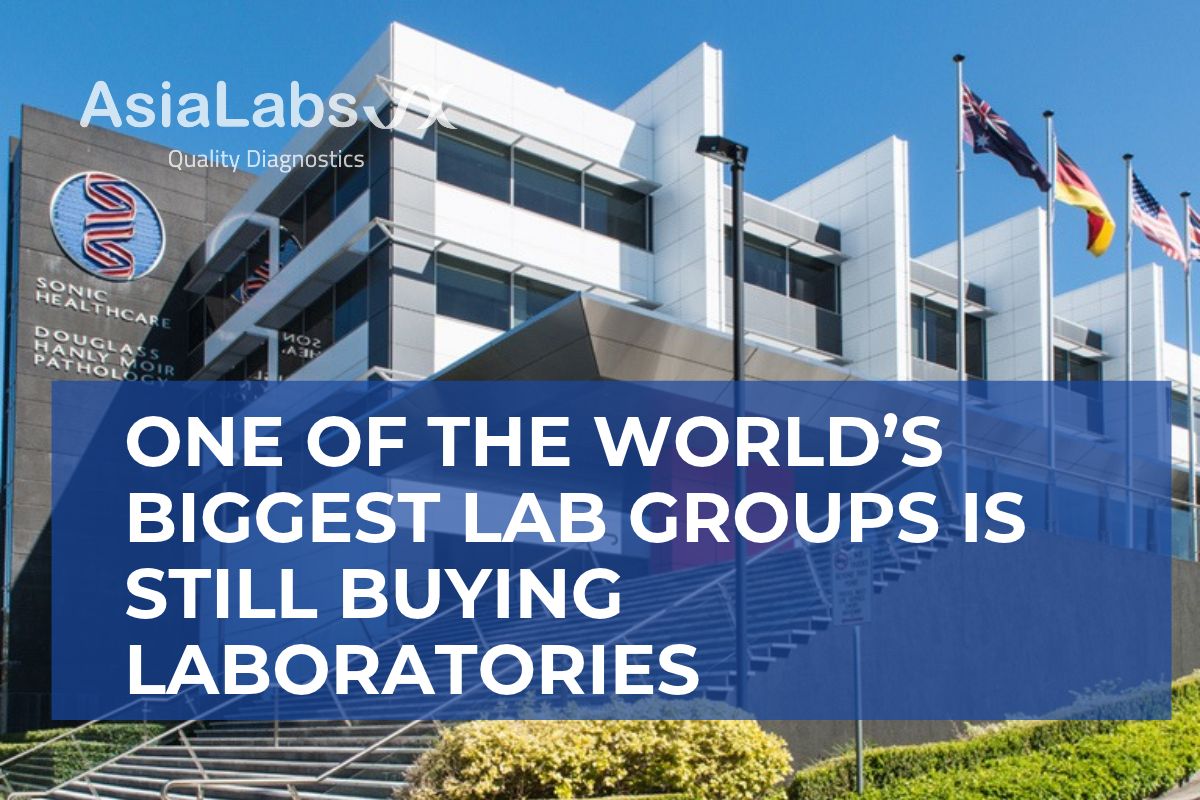
Sonic Healthcare started as a diagnostic laboratory business operating in one Australian state.
Today, its laboratory operations extend across Australia, North America and Europe.
Sonic describes itself as one of the world’s leading medical diagnostic companies and the third-largest provider of pathology and clinical laboratory services globally. Its FY2025 revenue reached approximately A$9.6 billion.
Yet despite already operating at international scale, Sonic Healthcare is still buying laboratories.
That tells us something important about the economics of diagnostic testing.
Large laboratory groups do not necessarily reach a point where acquisitions are no longer useful.
In many cases, greater scale can actually make acquisitions more valuable.
Why?
Because diagnostic laboratories can be local businesses and network businesses at the same time.
Patients and physicians are local.
But much of the infrastructure behind testing can potentially be shared across a much larger network.
That combination helps explain why consolidation has played such an important role in the development of major international laboratory groups — and why it could eventually matter for Vietnam.
Sonic Healthcare’s Expansion Was Built Across Multiple Markets
Sonic Healthcare began its pathology operations in New South Wales, Australia.
It subsequently expanded throughout Australia before building significant laboratory businesses in North America and Europe.
Today, the group has substantial operations in markets including Australia, Germany, Switzerland, the United Kingdom, Belgium and the United States.
This expansion did not happen only through opening new laboratories from scratch.
Acquisitions have repeatedly played an important role.
And that strategy continued in 2025.
One of Sonic’s most significant transactions was the acquisition of Laboratory Group Dr. Kramer & Colleagues, or LADR, one of Germany’s five largest medical laboratory groups.
The transaction was announced in December 2024 and completed on 1 July 2025.
LADR had approximately €370 million in annual revenue in 2024, while Sonic valued the business at an enterprise value of €423 million.
This was not a small local laboratory.
LADR operated a network of specialist laboratory practices and hospital laboratories across Germany, together with operations in Poland and an interest in Finland.
Sonic reports that LADR employed more than 2,800 full-time-equivalent staff, with its central laboratory located in Geesthacht, east of Hamburg.
For Sonic, the acquisition immediately increased its scale in one of its most important European markets.
Sonic Also Bought a Specialist Oncology Laboratory in the United States
The LADR transaction demonstrates geographic expansion.
Another 2025 acquisition illustrates a different strategy: acquiring specialised diagnostic capabilities.
In August 2025, Sonic acquired Cairo Diagnostics, a specialist laboratory focused on haematology-oncology diagnostics.
Cairo operates laboratories in White Plains, New York, and Woodcliff Lake, New Jersey.
According to Sonic, the business focuses on sophisticated and genetic testing for blood and other cancers and generated annual revenue of approximately A$35 million at the time of acquisition.
The interesting part is what Sonic planned to do next.
Rather than treating Cairo simply as a regional New York-area laboratory, Sonic said its strategy was to offer Cairo’s services nationally using Sonic’s existing infrastructure.
That is an important example of how laboratory networks create value.
Sonic was not merely buying another laboratory location.
It was acquiring specialised knowledge and testing capability that could potentially be distributed across a much larger customer and logistics network.
The Strategy Did Not Begin in 2025
Sonic’s acquisition activity in 2025 was part of a much longer pattern.
In 2024, the company expanded its German operations through acquisitions including Labor Dr. Hermann, Labor im Sommershof and Zentrum für Pathologie & Zytologie Düsseldorf.
It also acquired Dr Risch, a Swiss medical laboratory group employing around 650 staff across 13 clinical laboratories in Switzerland and another laboratory in Liechtenstein.
In the United States, Sonic acquired PathologyWatch, a dermatopathology company with its own end-to-end digital pathology platform.
PathologyWatch is particularly interesting because the acquisition was not only about additional testing volume.
Its platform combines laboratory information systems, digital pathology viewing, image storage and artificial-intelligence technology. Sonic subsequently began deploying the platform across its U.S. dermatopathology business.
This shows that laboratory M&A can serve multiple purposes.
A company can acquire:
geographic coverage;
testing volume;
specialist expertise;
hospital relationships;
technology;
or a combination of all five.
Why Can a Local Laboratory Be Valuable to a Global Group?
At first glance, laboratory medicine appears highly local.
A doctor orders a test locally.
A patient visits a collection centre close to home.
Blood is drawn locally.
Hospitals operate within specific cities and regions.
Relationships between physicians and laboratories are often built over years.
This makes local presence extremely valuable.
But only part of the laboratory value chain needs to remain local.
The specimen collection point should generally be convenient for the patient.
The physician relationship also needs local attention.
But once a specimen enters the laboratory network, the economics begin to change.
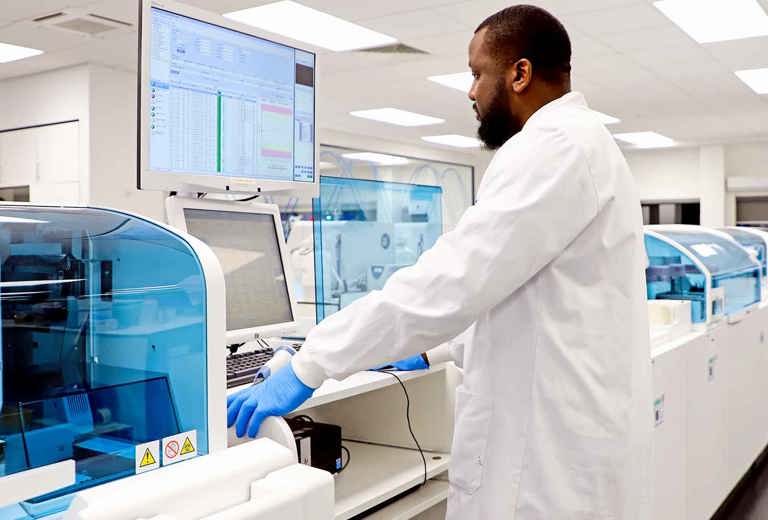
Some testing can be centralised.
Specialist pathologists can potentially serve much larger geographic areas.
Rare tests can be concentrated in reference laboratories.
Reagents and laboratory equipment can be purchased at larger scale.
Information technology can be standardised.
Logistics systems can connect collection points with regional and central laboratories.
Digital pathology can even allow diagnostic images to be reviewed by specialists located elsewhere.
This creates a powerful combination:
local access with centralised infrastructure.
Scale Can Make an Acquisition More Valuable
This helps explain why a large company such as Sonic can continue acquiring laboratories even after becoming one of the world’s largest diagnostic groups.
Imagine a small regional laboratory.
On its own, the business may need to maintain its own IT systems, procurement arrangements, specialist testing relationships, administrative functions and equipment.
Once incorporated into a larger network, some of those functions may potentially be shared.
At the same time, the acquired laboratory brings something the larger group cannot instantly manufacture:
local testing volume and relationships.
The larger group already has the infrastructure.
The local laboratory already has customers.
Combining the two can create economic value.
Sonic explicitly identified areas such as procurement, overlapping regional operations, specialist testing, logistics and equipment servicing as potential sources of synergies in the LADR transaction.
That is why laboratory consolidation is not simply about becoming bigger.
It is about making a network more efficient.
Laboratories Are Both Healthcare Facilities and Networks
The strategic lesson is that a diagnostic laboratory should not always be viewed as a standalone physical location.
It can also be understood as part of a network.
At the front end are patients, doctors, hospitals and collection centres.
Behind them are logistics systems moving specimens.
Further inside the network are routine laboratories, specialist departments and reference laboratories.
Supporting all of this are information systems, quality control, procurement, clinical expertise and technology.
A large diagnostic company can therefore operate many local access points while centralising selected capabilities.
This helps explain why laboratory consolidation can occur without reducing patient access.
The network may actually add more collection locations while concentrating expensive testing infrastructure into fewer, higher-volume centres.
What Could This Mean for Vietnam?
Vietnam is at a very different stage of laboratory market development.
The market remains significantly more fragmented.
Ken Research estimates that the Vietnam diagnostic laboratory market was worth approximately US$1.12 billion in 2025 and counts around 1,850 market participants.
The same research projects the market could grow to approximately US$1.83 billion by 2031, representing annual growth of around 8.53%.
If testing demand continues to increase while the industry remains fragmented, the next stage of development may not simply involve opening more laboratories.
It may also involve creating larger laboratory networks.
There are several possible routes.
Existing groups can expand organically.
Regional laboratories can form partnerships.
Hospitals can outsource selected testing.
Investors can provide capital for consolidation.
Larger diagnostic companies can acquire smaller laboratories.
Specialist laboratories can become part of broader platforms while continuing to operate under established local brands.
The exact structure will depend on regulation, ownership rules, valuation and healthcare economics in Vietnam.
But the fundamental network logic remains relevant.
Not Every Laboratory Needs to Become a National Company
Consolidation also does not mean every small laboratory needs to disappear.
Some laboratories may remain successful independent operators.
Others may specialise in particular disciplines.
But as diagnostic medicine becomes more technologically demanding, the economics of operating completely independently could become more challenging for some providers.
Molecular diagnostics, oncology biomarkers, genetics, specialised pathology, automation and digital laboratory systems all require investment.
Larger networks may be able to spread those investments across a greater volume of testing.
For a smaller laboratory owner, this creates an important strategic choice.
Continue investing independently?
Partner with a larger organisation?
Or sell part or all of the business and become part of a wider laboratory network?
These are the same types of decisions that have shaped more mature diagnostic markets.
Vietnam May Build Its Future Laboratory Groups Through Consolidation
Sonic Healthcare’s history demonstrates that some of the world’s largest laboratory groups are not necessarily built laboratory by laboratory from zero.
They can also be assembled.
One acquisition adds geographic coverage.
Another brings hospital relationships.
Another provides specialist diagnostics.
Another contributes technology.
Another adds testing volume.
Over time, these assets become connected through common infrastructure, logistics, IT, procurement and specialist expertise.
Sonic started as a laboratory operation in one Australian state.
Today, it operates across multiple continents.
And despite reaching that scale, it is still acquiring laboratories.
For investors watching Vietnam’s diagnostic sector, the lesson is important.
The next decade may certainly produce more laboratories.
But the bigger structural change could be the emergence of larger laboratory groups.
And some of those groups may not be built entirely from scratch.
They may be assembled —
one laboratory, one partnership and one acquisition at a time.